- On the Juice
- Posts
- The Downsides of Prediction Markets
The Downsides of Prediction Markets
Everything has its drawbacks
Thank you for being a reader.
If you want visibility into all of my wagers — subscribe to my profile on Juice Reel: InsiderOB.
I just hit 15 “Pick of the Day” bets in a row to win $1,000 (!!).
Last night was #15 with Ajay Mitchell staying under 11.5 points.

In the first two parts of this series, we stayed pretty friendly to prediction markets.
We talked about how they express everything as a probability and how to convert those probabilities into moneylines.
We looked at spots where they often beat or complement traditional sportsbooks on price or flexibility.
Today I’m going to flip it around.
I’ll highlight the drawbacks of prediction markets and the ways in which they lose out to traditional sportsbooks for most casual bettors.
I’ll specifically cover the following challenges:
Liquidity is often thin or lumpy.
Fees and duplicated markets can be confusing and erode profits.
You don’t get promos/boosts, which are a huge part of modern sportsbook EV for newer bettors.
After we walk through each one, I’ll close with our Bet(s) of the Week!
Let’s get after it.
Liquidity: The Ability to Bet Size at a Fixed Price
As long as you haven’t been “limited” for being too successful as a bettor, traditional sportsbooks offer a simple experience:
You see a bet you like at -110.
You type in $110.
You get filled instantly (within your limits for that market), all at that price.
Prediction markets are not that simple.
They operate with an order book:
There’s a stack of people wanting to bet “Yes” at different prices and sizes.
There’s a stack of people wanting to bet “No” at different prices and sizes.
The price and magnitude of your bet depends on what’s actually sitting there and how much you’re trying to get down.
That leads to one big issue.
The slippage problem
Example: Betting the Falcons to score under 20.5 points.

You see a bet you love at 54% implied (roughly -120 with fees) for an NFL team total under.
But there’s only $27 available at that price (see the far-right column above).
The next best offers are $72 at 59%, $30 at 60%, etc.
If you slam in $200, you don’t really “get 54%.” You’re getting a blended, worse price as you chew through the book all the way up to 61% (meaning part of your bet is at -156).
On a sportsbook, you might just have:
-125 available for your full stake, with clean sizing and no partial fills.
In that spot, “headline price” on the prediction market looks better, but your actual fill is worse once you get to a larger size (that is still pretty modest at $200).
Juice Reel can help you shop and find “great-looking” prices on prediction markets, but in some cases you can’t actually bet those numbers with meaningful stakes.
Confusing Markets and Fees
Unless you grew up trading futures or derivatives, the user experience on prediction markets is way more confusing than on retail sportsbooks.
Here are the two most confusing categories:
Market Duplication
For most sports bets I make on Kalshi, I see two markets representing the same bet, and they often show different prices (!!). WTF?
Here’s an example from tonight’s Trail Blazers vs. Pelicans game.
You can bet New Orleans to win on the moneyline by betting “Pelicans — Yes” at 39c with a limit order or 40c with a market order. Take a look:

Oddly, you can ALSO bet New Orleans to win on the moneyline by betting “Trail Blazers — No”. In this case, you get better pricing - 38c with a limit order and 39c at market.
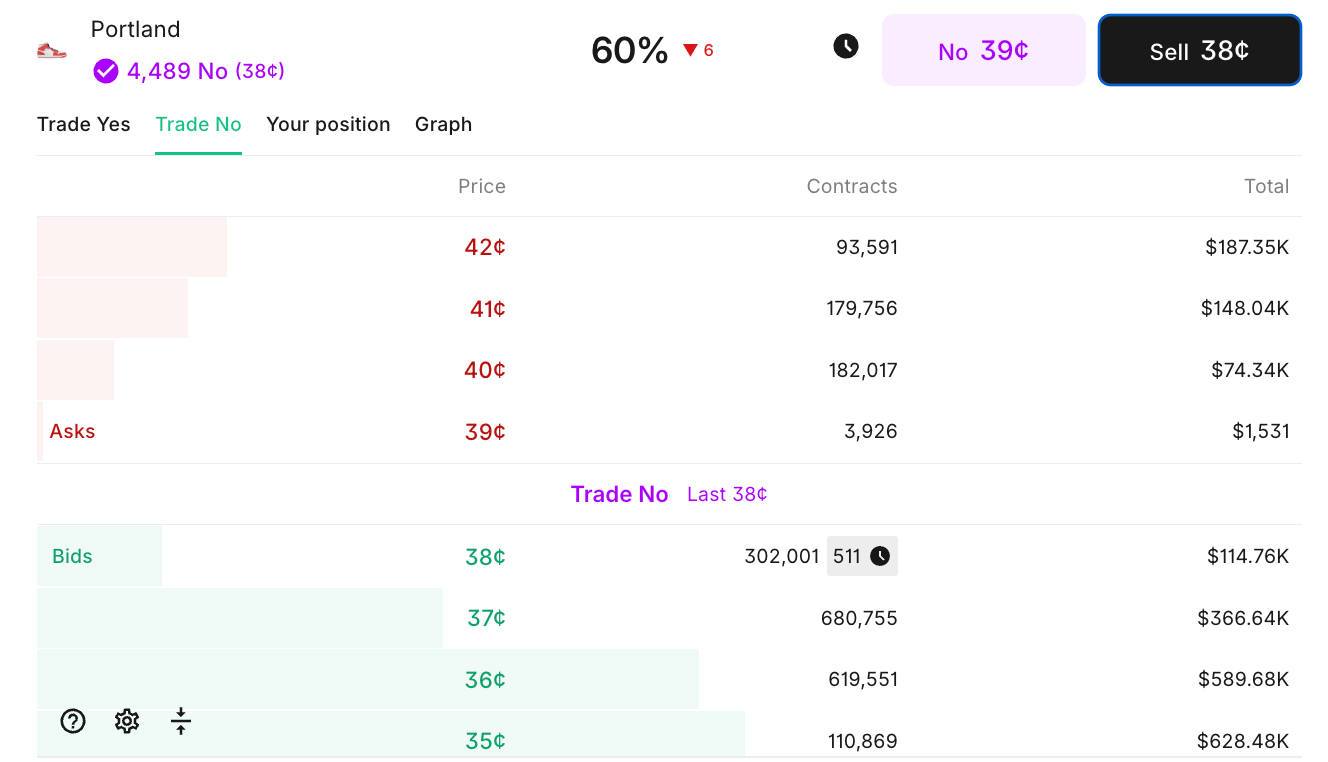
What does this mean, you ask?
You’ll just need to check both markets to find the best price before placing your bet. I wish I had a better explanation.
Fee Complexity
Kalshi’s fee schedule is so complex, they need a seven-page PDF to explain it.
In short, you pay smaller fees when trading bets that are extremely likely or extremely unlikely to win ($0.07 per hundred contracts when trading at 1c or 99c).
You pay larger fees when trading on 50/50 bets ($1.75 per hundred contracts on coin flip bets).
You’ll also typically pay larger fees for market orders (that are filled immediately) than for limit orders (where you’ll need someone to meet your price).
The easiest way to understand fees is to hover over the question mark in that module before betting.
Here’s a visual showing the $1.42 in fees I’d pay for 100 contracts at 72c tonight:
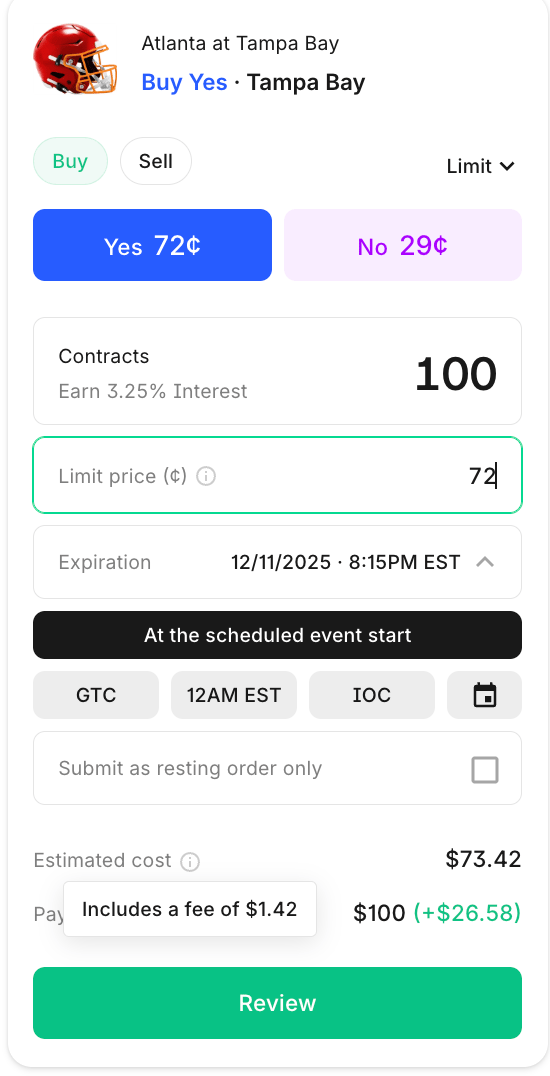
Hopefully this is helpful in deciphering the strange user experience you may encounter.
No Promotions or Offers
Modern sportsbooks are basically two products:
The raw odds (which build in a moderate to large house edge).
The promos/boosts (which, if used well, can be very profitable).
Prediction markets do not run a business model that supports category 2.
No:
Odds boosts
Profit boosts
Bet credits
Risk-free-ish “bet & get” offers
Insurance on parlays, etc.
For a sharp bettor with a serious edge, that’s fine.
For a recreational bettor who’s willing to be disciplined, it’s a big loss, as frequent promotions offer a lot of value when used well.
For readers of this newsletter who are not betting for consistent profit, the priority stack should be:
Crush promos and boosts intelligently on regulated books.
Line shop aggressively across books (including prediction markets).
Incorporate prediction markets as a niche tool where you have a pricing or market advantage.
Bet(s) of the Week $$
Last week we disappointingly dropped both bets.
The Dallas Cowboys and BYU Cougars were both plagued by turnovers and failed to cover, dropping 1.65 units.
Even so, since starting the newsletter, bets in this section are ahead 22.45 units, with a positive 17% ROI. We’ll update this regularly.
Based on my research, I am making the following bets this week:
New Orleans Pelicans +4 @ -110 on Fan Duel for 0.5 units (Tonight)
Even though New Orleans is just 3–22 straight up, they’ve covered close to 60% of their games this year and have a strong ATS record at home when catching 4+ points. I like them to break through with a win, but I’ll take the four points at home to account for their inexperience and poor closing.
Bengals +3 @ -115 on Fanatics for 1 unit (Sunday)
Baltimore is still being priced like Lamar is healthy, but he’s now under 60% completions in five straight games with rising sack and turnover rates, including three giveaways and a 65.4 passer rating in that 32–14 loss to these same Bengals. I think his athleticism is being hampered by injury and see value in fading the Ravens.
Please fill out the survey about today’s newsletter and let me know your thoughts!
How did you like this edition?I'd love to hear from you |
Reply